
1. What is a polygraph (lie detector) test?
The polygraph is a scientific instrument designed specifically to record various physiological changes that occur in the human body at the time case relevant questions are asked. The Examiner looks for those changes indicative of deception and forms an opinion about the examinee’s truthfulness, based on certain specific criteria.
2. Is polygraph testing legal in South Africa?
Yes. There’s no law against using a polygraph test in South Africa. However, it must be voluntary and you must give written consent before taking the test. Forcing someone to take a test can violate their constitutional rights.
3. Can my employer force me to take a polygraph?
Polygraph testing is a consensual process. Nobody can be forced to undertake an examination, under any circumstances. This does not mean, however, that investigations into perceived areas of risk and/or into any specific incident cannot proceed and that a mere refusal effectively shuts down the ability of any given party to pursue such instances. In short, standard investigative methods will have to be followed under such circumstances. We have developed very effective ways of dealing with such cases, the methodologies of which are supported by case law.
4. Can polygraph results be used in court or CCMA hearings?
In terms of the Law of Criminal Procedure and Evidence, the only test as to admissibility of any form of evidence into any given judicial forum, is relevance. Once admitted, it is up to the presiding officer to attach weight and value to any such evidence. As such, polygraph testing and the results of such tests, as well as the evidence gathered during such processes is acceptable and can be admitted into evidence at disciplinary hearings, the CCMA, labour court and in some circumstances, our criminal courts. Of primary importance in all such instances is the ability of the examiner to have himself/herself declared both a specialist and reliable witness. This will require sound credentials and references, as well as very detailed knowledge of the processes, procedures, ethics and application of polygraph testing. The ability to testify with authority and competence as to the evidence gathered by way of such interventions is crucial and cannot be overstated. All True Lies Polygraph Examiners are trained to international standards and also undergo additional, advanced training on a regular basis to ensure that their skills are current, relevant and of course admissible in terms of the laws governing the collection and presentation of evidence gathered during our investigative processes. Care is also taken to regularly test all polygraph equipment utilized by our Examiners and equipment functionality certifications are renewed as required.
5. How accurate are polygraph tests?
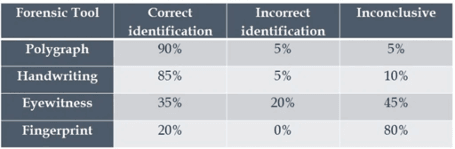
There have been more than 100 published scientific studies of the accuracy of polygraph testing. On average, the overall accuracy of a properly administered polygraph test has been found to be in the region of between 88% and 92%, depending on the format of testing used. The accuracy rate of the process is, however, dependent on many factors. Research on the various formats and research projects undertaken in this regard are available here. Polygraph compares favourably to other forensic tools used, as can be seen in the table below. In clarity, we would like to add that the percentages indicate the ability of the listed methodologies to identify the perpetrator and are not reflective of the processes themselves. It is vitally important to note, however, that the expertise of the polygraph examiner ultimately determines the success or failure of the entire process. If standards are not met and the correct protocols not followed, the entire polygraph examination will be irreversibly flawed. It must be remembered that, as is the case with all forensic evidentiary processes, polygraph is a tool and not a comprehensive solution to any investigative situation. Only engage appropriately skilled polygraph examiners who maintain international testing standards and who are able to explore the evidence gathered during such undertakings, as mere pass or fail results have little or no value in reducing risk within any given environment, without substantiating evidence or where questionable and/or sub-standard processes are evident. All our polygraph examiners are internationally accredited and work to strict standards. They are all well qualified and have extensive investigative backgrounds. Resolution of failed test outcomes is our forte, with complete resolution of all tasks undertaken our main objective.
6. What kinds of questions will be asked?
Questions are carefully designed and fall into three categories:
• Relevant questions – linked to the issue being investigated (e.g., theft, infidelity, security breach).
• Comparison (Control) questions – general questions used to compare your physiological responses.
• Neutral questions – unrelated to the case, used to establish a baseline.
You will know all the questions before the test begins.
7. What happens during the polygraph process?
When you first meet with the Examiner, he will be seated in a fairly quiet room, where disturbance can be avoided. Your rights in terms of the test will be explained and you will be asked to sign a statement indicating your willingness to participate. The Examiner will then collect basic data about you, for the purpose of the test. General questions about health and for example substance abuse may be asked. These questions help the Examiner to determine if any suitability problems exist that could have an adverse impact on the testing process. The Examiner will comprehensively discuss the format of the test with you, certain aspects of your personal history which may have a bearing on the test, as well as the workings of the polygraph instrument. Once the preliminary questions have been asked and information obtained, you and the Examiner will discuss the matter under investigation. During this part of the test, you are given the opportunity to explain what you know about the matter under investigation. You and the Examiner will discuss the allegations (specific issue testing) or your background (pre-employment testing). After discussing the matter under investigation, you and the Examiner will discuss questions to be asked during the data collection phase. You will be informed of the exact wording of each and every question to be asked during the test. If you are not told what questions are going to be asked, you should not take the test. If you are mistreated in any way or asked unusual or improper questions, report the incident immediately to the most senior member of management available on the day. The entire polygraph process must be recorded on video camera. Should you need to rely on physical evidence to prove that the correct procedure had not been followed, this will be made available.
8. Who can see my results?
The forensic report is released to the individual or company authorised representative who requested the polygraph examination only. This is usually the person who signed the investigative mandate initiating the intervention.
9. Why are polygraphs used in South Africa?
Common uses include:
• Workplace investigations – theft, fraud, policy violations.
• Pre-employment screening – especially for security-sensitive jobs.
• Criminal investigations – as supporting evidence.
• Personal matters – infidelity disputes, family conflicts.
• Security clearances – for sensitive or high-trust positions.
10. How much does a polygraph test cost?
At True Lies Forensics we conduct investigative polygraph examinations which are comprehensive in nature, in respect of all three stages of testing (pre-test phase, in-test phase and post-test phase). We charge R750.00 per hour excluding VAT. Pricing is case dependant.